
Conversion from NFA to RE
Introduction
The equivalence between Nondeterministic Finite Automata (NFAs) and Regular Expressions (REs) represents a fundamental result in formal language theory, establishing that these two distinct representational models have identical expressive power for describing regular languages. While NFAs provide an intuitive visual approach through state diagrams and transition mechanisms, regular expressions offer a concise algebraic notation that captures the same language patterns through symbolic operations.
Understanding this equivalence is essential for computer science students as it bridges the conceptual gap between operational automata-based recognition and declarative pattern-based specification. The transformation from NFAs to regular expressions through state elimination demonstrates how visual state machines can be systematically converted into textual patterns, a process fundamental to compiler construction, lexical analysis, and text processing applications.
Nondeterministic Finite Automata (NFAs)
Formal Definition
A Nondeterministic Finite Automaton is a 5-tuple M = (Q, Σ, δ, q₀, F) where:
- Q: Finite set of states
- Σ: Input alphabet
- δ: Transition function δ: Q × (Σ ∪ {ε}) → P(Q)
- q₀: Start state (q₀ ∈ Q)
- F: Set of accepting states (F ⊆ Q)
NFA Characteristics
NFAs exhibit several key properties that distinguish them from deterministic automata:
- Nondeterminism: Multiple transitions possible from a single state on the same input
- Epsilon transitions: Transitions without consuming input symbols
- Multiple accept paths: A string is accepted if any computation path leads to an accepting state
- Computational flexibility: Can "guess" correct paths through nondeterministic choices
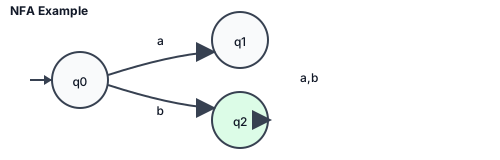
Example: Language L = {w | w contains 'ab' as substring}
For recognizing strings containing the substring 'ab':
States: {q₀, q₁, q₂} where q₀ is start, q₂ is accepting
Key transitions:
- δ(q₀, a) = {q₀, q₁} - Stay in q₀ or advance to q₁
- δ(q₁, b) = {q₂} - Complete 'ab' pattern
- δ(q₂, a) = δ(q₂, b) = {q₂} - Accept all suffixes
Regular Expressions (REs)
Formal Definition
Regular expressions are built recursively from:
- ∅: Empty set (no strings)
- ε: Empty string
- a: Single symbol (a ∈ Σ)
- Union: r₁ ∪ r₂ (either pattern)
- Concatenation: r₁r₂ (sequential patterns)
- Kleene Star: r* (zero or more repetitions)
Regular Expression Operations
- Union (|): Alternation between patterns
- Concatenation: Sequential composition of patterns
- Star (*): Repetition operator (zero or more)
- Plus (+): One or more repetitions (r⁺ = rr*)
- Optional (?): Zero or one occurrence (r? = r ∪ ε)
Example: Language L = {w | w contains 'ab' as substring}
The same language expressed as regular expression: (a|b)ab(a|b)
- (a|b)* - Any prefix of a's and b's
- ab - Required substring
- (a|b)* - Any suffix of a's and b's
State Elimination Algorithm
Overview
The state elimination method systematically converts an NFA to a regular expression by:
- Preparation: Ensure single start and accept state
- Elimination: Remove intermediate states while preserving language
- Edge consolidation: Update transition labels with regex operations
- Final extraction: Derive final regular expression
Detailed State Elimination Process
Step 1: NFA Preprocessing
- Single start state: Add new start state if multiple initial states
- Single accept state: Add new accept state if multiple final states
- Epsilon elimination: Convert epsilon transitions to direct regex labels
Step 2: State Selection Strategy
Choose intermediate states for elimination in strategic order:
- Non-critical states: States not heavily connected
- Minimal disruption: States requiring fewest new transitions
- Complexity management: Avoid creating overly complex intermediate expressions
Step 3: Transition Recalculation
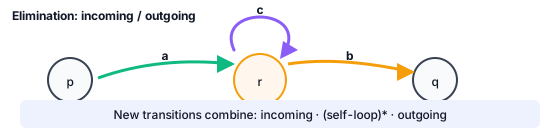
For each eliminated state s with:
- Incoming transitions: {(pᵢ, aᵢ, s)} from states pᵢ
- Outgoing transitions: {(s, bⱼ, qⱼ)} to states qⱼ
- Self-loop: (s, c, s) if present
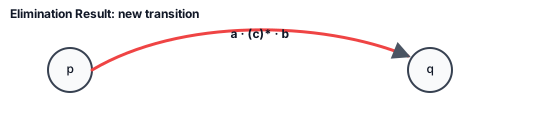
Create new transitions: (pᵢ, aᵢc*bⱼ, qⱼ) for all combinations
Step 4: Regex Construction Rules
- Sequential elimination: Concatenate transition labels
- Self-loop handling: Apply Kleene star to loop expressions
- Multiple paths: Unite parallel transitions with union operator
- Simplification: Apply algebraic laws to reduce complexity
Theoretical Foundations
Equivalence Theorem
Theorem: A language L is accepted by some NFA if and only if L can be expressed by some regular expression.
This equivalence is established through constructive proofs in both directions:
NFA to RE Construction (State Elimination)
- Systematic removal: Eliminate states while preserving accepted language
- Regex algebra: Combine transition labels using concatenation, union, and star
- Termination guarantee: Process always produces valid regular expression
RE to NFA Construction (Thompson's Algorithm)
- Compositional building: Construct NFAs for basic patterns
- Recursive combination: Merge component NFAs using epsilon transitions
- Structural preservation: Maintain correspondence between expression and automaton
Practical Implementation Details
Edge Label Management
During state elimination, transition labels evolve from simple symbols to complex expressions:
- Initial labels: Single symbols or symbol sets
- Intermediate expressions: Unions and concatenations of subpatterns
- Final form: Complete regular expression capturing original language

Complexity Considerations
- Expression growth: Regex size can grow exponentially with automaton size
- Elimination order: Strategic state selection minimizes intermediate complexity
- Algebraic simplification: Apply regex laws to reduce expression size
- Practical limits: Large automata may produce unwieldy expressions
Applications and Examples
Compiler Design
State elimination connects theoretical equivalence to practical applications:
- Lexical analysis: Convert token patterns to finite automata
- Scanner generation: Transform regular expressions to efficient recognizers
- Optimization: Choose representation based on performance requirements
Text Processing
Regular expressions derived from automata serve various applications:
- Pattern matching: Search and replace operations in text editors
- Input validation: Form field checking and data sanitization
- Log parsing: Extract structured information from unstructured text
Formal Verification
The NFA-RE equivalence supports verification methodologies:
- Property specification: Express system behaviors as regular patterns
- Model checking: Verify finite-state systems against regular properties
- Protocol analysis: Model communication patterns using automata
Advanced Topics
Optimization Strategies
Efficient state elimination requires careful consideration:
- Elimination ordering: Minimize intermediate expression complexity
- Expression simplification: Apply algebraic laws during construction
- Caching: Reuse computed subexpressions when possible
- Heuristics: Use domain knowledge to guide elimination choices
Alternative Conversion Methods
Beyond state elimination, other approaches exist:
- Matrix methods: Linear algebraic approach using transition matrices
- Brzozowski's algorithm: Reverse and determinize operations
- Derivatives: Symbolic differentiation of regular expressions
Complexity Analysis
- Space complexity: Regex size potentially exponential in NFA size
- Time complexity: Elimination algorithm polynomial in NFA size
- Practical bounds: Real-world expressions often remain manageable
- Trade-offs: Balance between compactness and computational efficiency